


Should Every Room Use the Same Steel Radiator?
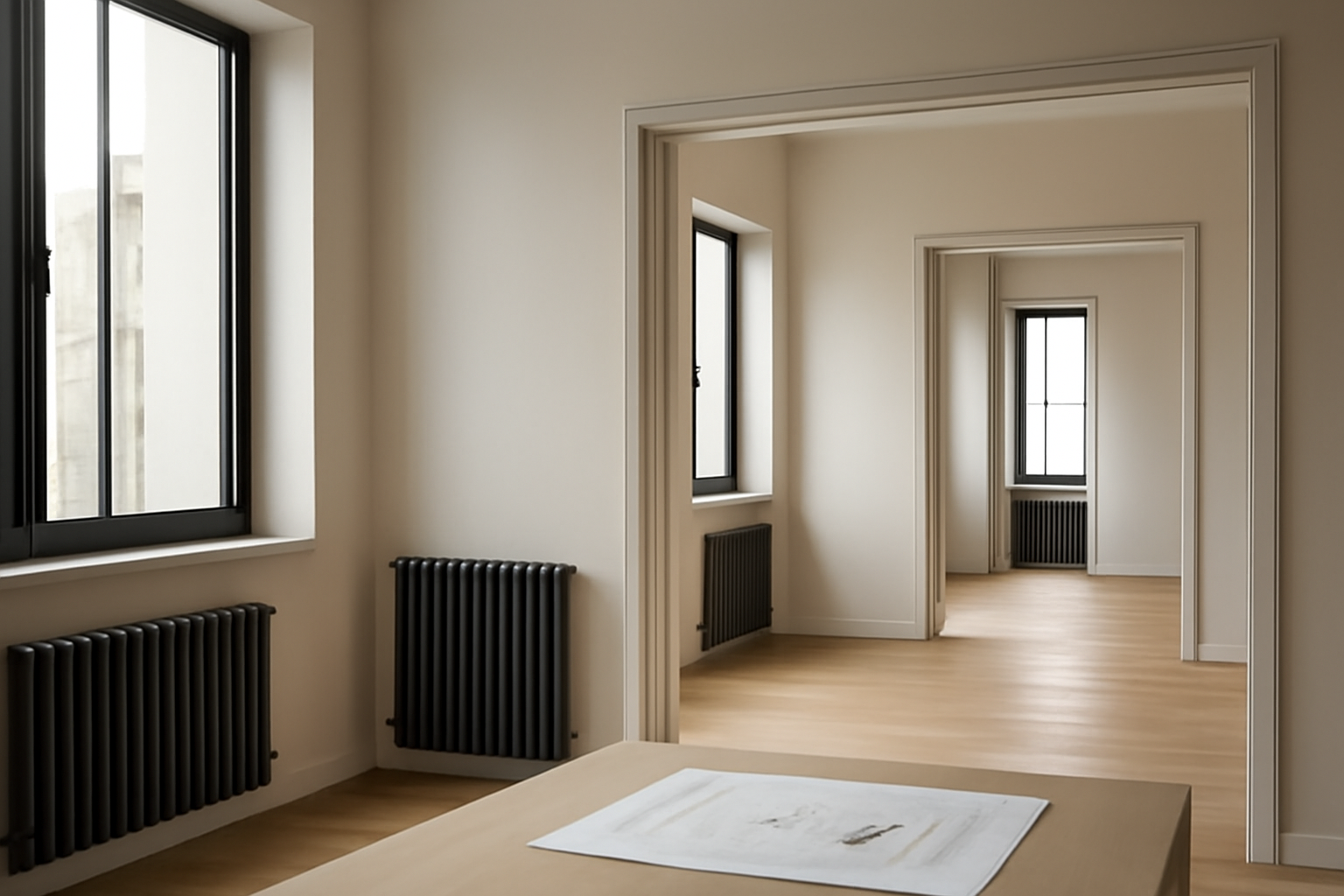
Should Every Room Use the Same Steel Radiator?
Standardizing radiators across a residential, commercial, or hospitality project can make procurement easier, simplify installation, reduce spare-parts requirements, and create a cleaner visual language. However, using exactly the same steel radiator in every room is not always the best way to achieve reliable comfort.
The right approach is not to choose one model blindly and repeat it everywhere. Instead, successful steel radiator selection for multi-room projects combines standardization with room-by-room heat calculations, consistent design rules, and a controlled range of radiator sizes or configurations.
This framework explains how to decide what should be standardized, what should remain flexible, and how to protect heat output while keeping the project commercially efficient.
Why Project Buyers Want Radiator Standardization
Large projects often involve dozens or hundreds of radiators. Without a clear specification, every room can end up with a different model, connection arrangement, finish, or accessory package. That creates unnecessary complexity for the designer, contractor, installer, and purchasing team.
A well-planned steel radiator standardization strategy can provide several advantages:
- Simpler procurement: Fewer product families and dimensions make ordering and delivery easier.
- Faster installation: Installers work with repeatable brackets, connections, and mounting details.
- Cleaner appearance: Similar rooms maintain a consistent visual style.
- Easier maintenance: Building operators can stock fewer replacement components.
- Lower specification risk: A controlled product range reduces the chance of incompatible valves, brackets, or connections.
- More predictable budgeting: Repeat quantities can improve cost planning and reduce emergency substitutions.
These benefits are real, but standardization should support performance rather than override it. A radiator that looks consistent but cannot deliver the required output will create comfort complaints, balancing problems, and costly changes later.
Can the Same Steel Radiator Be Used in Every Room?
Sometimes, yes. If rooms have similar dimensions, insulation levels, external exposure, window areas, ceiling heights, and design temperatures, one radiator model may work across much of the project. The model can then be adjusted through its length, height, panel type, or number of panels to meet different heat requirements.
However, the same physical radiator size is rarely suitable for every room. A small internal bedroom, a large living area with two external walls, and a bathroom with high ventilation demand do not usually have identical heating loads.
The practical distinction is important:
- Standardize the product family whenever possible.
- Standardize connection details and accessories where the installation allows it.
- Allow radiator dimensions or types to vary when room heat demand requires it.
This gives the project a consistent system without forcing every room into the same thermal solution.
Start with a Room-by-Room Radiator Schedule
The foundation of reliable selection is a detailed room-by-room radiator schedule. This schedule should connect each room to its calculated heat requirement and the exact radiator specification proposed for that location.
At minimum, include the following information:
| Schedule Item | Why It Matters |
|---|---|
| Room name and floor | Identifies the location and supports installation coordination. |
| Room dimensions | Provides the basis for estimating heating demand. |
| External walls and windows | Highlights rooms with greater heat loss. |
| Required heat output | Defines the minimum radiator performance needed. |
| Radiator model and dimensions | Connects the heat requirement to a procurement item. |
| Connection type and side | Prevents installation conflicts with pipework. |
| Valve and accessory requirements | Ensures the complete system is compatible. |
| Finish and color | Maintains architectural and interior-design consistency. |
A schedule also creates a single source of truth. If the architectural layout changes, the design team can update affected rooms without losing control of the entire radiator package.
Understand Heat Output by Room
Radiator selection must be based on required heat output, not simply on room area or visual preference. Heat output by room depends on factors such as room dimensions, insulation, glazing, external surface area, ventilation, local climate, desired indoor temperature, and the position of the room within the building.
Radiator output also depends on the radiator itself. Important variables include design, dimensions, number of panels or convector elements, water temperature, flow conditions, and the test standard or test conditions used to report performance.
For this reason, two radiators with similar external dimensions may not provide identical output. Likewise, a radiator rated at a particular output under one water-temperature condition may deliver less heat in a lower-temperature system.
Before approving a model, confirm:
- The project’s required room heat load.
- The heating system’s flow and return temperatures.
- The stated output test conditions for the radiator.
- The design margin required by the engineer or project specification.
- The effect of thermostatic control and system balancing.
When comparing products, use like-for-like output data. A rating based on higher water temperatures should not be compared directly with a low-temperature system requirement without proper adjustment.
What Should Be Standardized?
The most effective steel radiator project specification usually standardizes a platform rather than a single universal size. The platform may define the preferred radiator family, panel construction, finish, mounting approach, valve compatibility, and acceptable size range.
1. Standardize the radiator family
Selecting one primary steel radiator family can simplify design reviews, purchasing, delivery, and maintenance. Where output requirements vary, different heights, lengths, or panel configurations within the same family may be used.
2. Standardize the finish
A consistent finish helps coordinate radiators across bedrooms, offices, corridors, and public areas. The specification should identify the required color, surface quality, and approval process rather than relying on informal descriptions.
3. Standardize connection principles
Consistent connection locations and valve arrangements can reduce installation errors. Nevertheless, the final connection detail must reflect the pipework layout, radiator orientation, accessibility, and manufacturer-approved installation method.
4. Standardize accessories
Thermostatic valves, lockshield valves, wall brackets, air vents, plugs, and fixing components should be coordinated as one package. A radiator order is incomplete if the accessories do not match the selected model or site conditions.
5. Define acceptable substitutions
Projects should identify whether substitutions are allowed and what evidence is required. A substitute should match the required output, dimensions, connection arrangement, operating conditions, material requirements, and finish—not merely the approximate appearance.
When One Radiator Type Is Not Enough
A controlled project may still require more than one radiator configuration. This is not a failure of standardization; it is often the correct design decision.
| Project Condition | Recommended Approach |
|---|---|
| Similar bedrooms with comparable heat loads | Use one radiator family with a limited range of lengths. |
| Large living rooms or open-plan areas | Use longer or higher-output versions, or multiple radiators for better distribution. |
| Rooms with large glazing areas | Check perimeter heat loss and consider radiator positioning near cold surfaces. |
| Bathrooms or humid spaces | Use a suitable radiator type and finish for the environment and required output. |
| Low-temperature heat-pump systems | Verify output at the actual design water temperatures; larger emitters may be necessary. |
| Architectural feature walls | Coordinate dimensions and connections early to avoid compromising heat delivery. |
| Renovation projects with limited pipework changes | Prioritize compatible connection dimensions and installation access. |
Where Stainless Steel 304 Fits into the Specification
Some projects require or prefer stainless steel construction, particularly where durability, appearance, or environmental resistance is important. Stainless steel 304 is an austenitic stainless steel that contains chromium and nickel and is widely used because of its strong general corrosion resistance and stable, clean appearance in many indoor applications.
However, stainless steel 304 should not be treated as an automatic indicator of higher heat output. Thermal performance is governed primarily by the radiator’s design, active surface area, dimensions, water temperature, flow, and test conditions. A 304 stainless steel radiator can be an excellent material choice, but its output still needs to be checked against the room requirement.
For project procurement, ask for clear documentation confirming the stated material grade, product construction, dimensions, operating limits, finish, and output test basis. Material selection and heat-emission performance are related to the overall product design, but they are not the same specification point.
A Practical Buying Framework
Use the following process to control both performance and procurement efficiency.
Step 1: Divide rooms into heat-demand groups
Group rooms with similar requirements, such as standard bedrooms, offices, living spaces, bathrooms, corridors, and high-glazing areas. This creates a manageable range of radiator solutions.
Step 2: Set the project design conditions
Confirm indoor design temperatures, flow and return temperatures, heat-source type, control strategy, and applicable output test conditions before comparing models.
Step 3: Select a primary product family
Choose a radiator family that can cover the expected output range without introducing unnecessary variations. The family should support the project’s dimensions, connections, appearance, and maintenance requirements.
Step 4: Build the radiator schedule
Assign a model, size, quantity, location, connection detail, and output to every room. Avoid vague descriptions such as “standard radiator” without a measurable size or performance requirement.
Step 5: Review installation constraints
Check wall construction, bracket positions, skirting, curtains, furniture, pipe routes, valve access, and clearance from floors and adjacent surfaces. A correctly sized radiator can still perform poorly if it is obstructed or installed incorrectly.
Step 6: Lock procurement information
Before ordering, confirm model references, dimensions, finish, material, accessories, packaging, delivery sequence, and approved substitutions. Make sure the supplier quotation matches the final schedule line by line.
Radiator Procurement Checklist
- Has every room been assigned a required heat output?
- Were output values checked at the project’s actual water temperatures?
- Does the selected radiator family cover the required range?
- Are dimensions compatible with available wall space?
- Are pipe connections and valve positions coordinated?
- Are brackets, air vents, plugs, and valves included?
- Is the material grade clearly stated where stainless steel is required?
- Are finish, color, and surface requirements documented?
- Are bathrooms and other demanding environments specified correctly?
- Does the schedule identify approved alternatives and substitution rules?
- Has delivery been coordinated with the installation sequence?
- Will the installed system be balanced and commissioned?
Common Mistakes to Avoid
Choosing by length alone
A longer radiator is not automatically the correct solution. Output depends on the complete design and operating conditions, not length in isolation.
Using one size everywhere
This may simplify ordering but can leave larger or more exposed rooms underheated while smaller rooms receive unnecessary capacity.
Ignoring low-temperature operation
Radiators selected for conventional high-temperature systems may not provide the required output when connected to a heat pump or another lower-temperature system.
Separating design from procurement
If the purchasing team receives only a product name without room locations, sizes, outputs, and connection details, errors become much more likely.
Accepting unverified substitutions
Similar appearance does not guarantee equivalent output, materials, connections, or mounting requirements. Every substitution should be technically reviewed.
FAQ
Should every room in a project use the same steel radiator model?
Not necessarily. It is usually better to standardize the radiator family, finish, accessories, and installation principles while allowing dimensions or configurations to vary according to each room’s heat requirement.
Can radiator selection be based on room area?
Room area can support an early estimate, but final selection should consider insulation, windows, external walls, ventilation, design temperature, water temperature, and the radiator’s tested output.
Why is a room-by-room radiator schedule important?
It links each room to a defined heat output, model, size, location, and connection detail. This improves coordination between design, purchasing, installation, and commissioning.
Does stainless steel 304 produce more heat than ordinary steel?
Not automatically. Stainless steel 304 is a material grade with useful corrosion-resistance properties, but heat output depends on radiator design, dimensions, water temperature, flow, and test conditions.
What is the best strategy for low-temperature heating systems?
Verify radiator output at the actual design flow and return temperatures. If output is insufficient, use a larger radiator, a higher-output configuration, or additional emitters while maintaining proper room distribution.
How many radiator models should a multi-room project use?
There is no universal number. The target should be the smallest controlled range that meets the project’s heat loads, architectural constraints, environmental conditions, and installation requirements.
Conclusion
The best approach to steel radiator selection for multi-room projects is controlled flexibility. Standardize the product family, finish, accessories, and connection principles, but let heat output by room determine the final size and configuration. With a detailed room-by-room radiator schedule, verified operating conditions, and a disciplined procurement checklist, project teams can achieve a consistent appearance and efficient purchasing without sacrificing comfort or technical performance.
Contact Us
For product information and help choosing the right solution, contact Isti Radiator.