


Can a Decorative Radiator Go in a Wall Niche? Planning Shelves, Screens, and Clearances
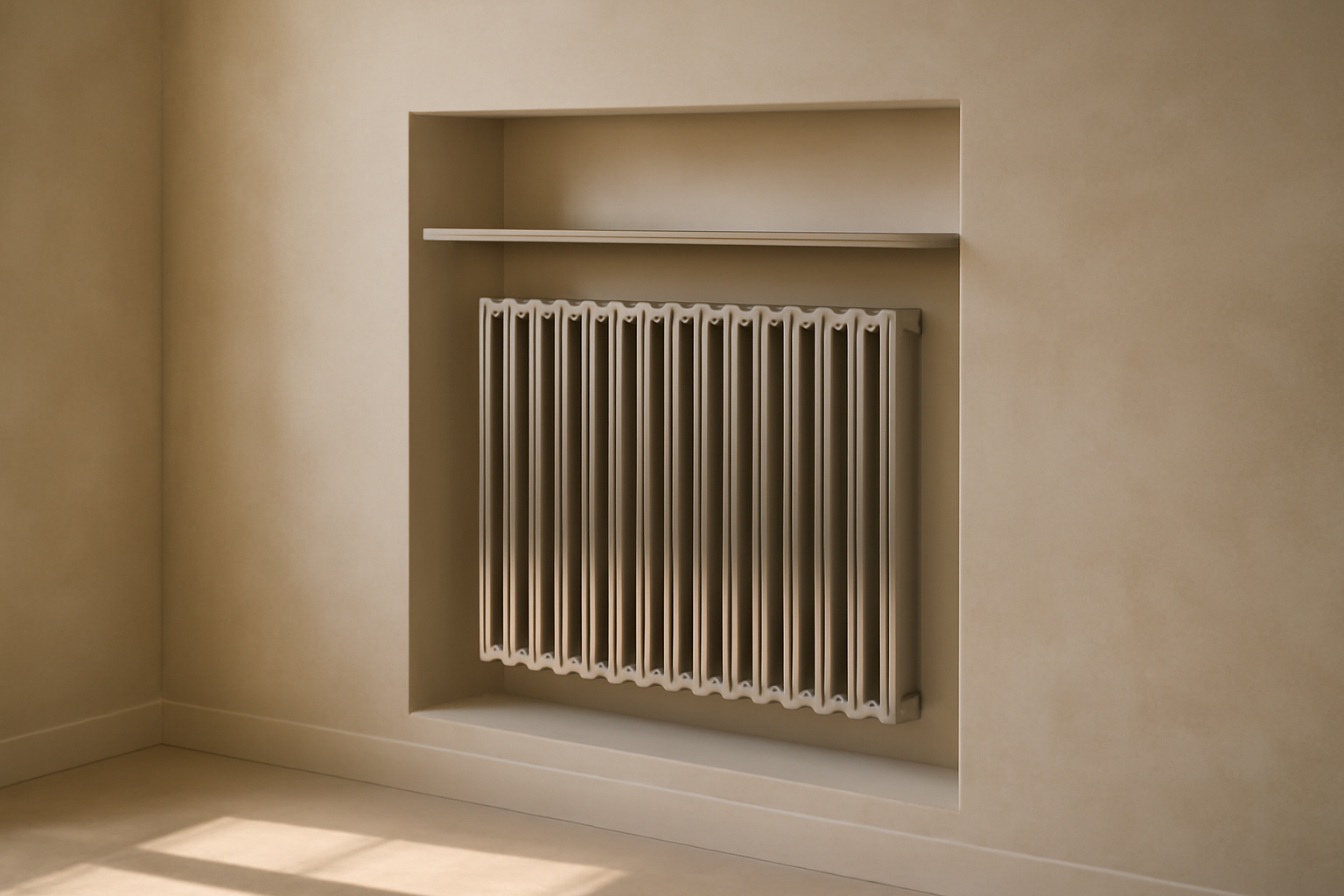
Can a Decorative Radiator Go in a Wall Niche?
Yes, a decorative radiator can go in a wall niche, but the recess must be designed around airflow, service access, heat transfer, and the radiator’s actual dimensions. A niche can make a radiator look built-in and intentional, especially in hallways, living rooms, bedrooms, and period-style interiors. However, enclosing the radiator too tightly may restrict convection, reduce useful heat output, damage nearby finishes, or make future maintenance unnecessarily difficult.
The right approach is to treat the recess as part of the heating system rather than as a purely decorative feature. The radiator needs room for air to enter at the bottom, warm air to rise, and heat to move into the room. Shelves, screens, cabinetry, and trim can all work, provided they are planned with ventilation and clearance in mind.
What Is a Decorative Radiator Niche?
A decorative radiator niche is a recessed section of a wall designed to house a radiator while creating a cleaner architectural finish. It may be a shallow plasterboard recess, a deeper masonry opening, or a framed feature with a shelf or decorative screen.
The niche can be used to:
- Make a radiator appear more integrated with the room’s architecture.
- Create a defined location for pipework and radiator valves.
- Add a shelf, ledge, or trim detail above the radiator.
- Coordinate the radiator with wall panelling, joinery, or period interiors.
- Protect the radiator from accidental knocks in narrow areas.
The key limitation is that a radiator still needs to release heat efficiently. A niche should frame the radiator, not seal it inside an unventilated box.
Can Any Radiator Be Installed in a Wall Recess?
Many panel, column, tubular, and designer radiators can be installed within a wall recess, but suitability depends on the model, connection arrangement, mounting system, and available space. A radiator with side connections may require more lateral room than one with bottom connections. A deep column radiator may need a substantially deeper niche than a slim flat-panel model.
Before construction begins, confirm:
- The radiator’s overall height, width, and depth.
- The position and type of wall brackets.
- The location of the flow and return connections.
- The position of the air vent, drain point, and thermostatic valve.
- The manufacturer’s recommended installation clearances.
- Whether the wall can support the radiator and its water-filled weight.
Do not size the niche from the nominal radiator dimensions alone. Allow space for brackets, valves, pipe bends, skirting, wall irregularities, finishing materials, and future removal.
Planning Decorative Radiator Clearance
Decorative radiator clearance is the space around the radiator that allows air movement, heat distribution, cleaning, and servicing. Exact dimensions vary by radiator design and installation instructions, but the following planning principles are widely useful.
Clearance below the radiator
Leave an open gap below the radiator so cooler room air can enter and rise through or around the heating surface. If the radiator is installed directly on the floor or behind a deep plinth, convection can be restricted.
A practical design often leaves approximately 100 to 150 mm between the finished floor and the bottom of the radiator, although the correct distance depends on the radiator and bracket system. Keep this area free from solid trim, storage boxes, and dense decorative panels.
Clearance above the radiator
Warm air rises, so the space above the radiator is especially important. A shelf or lintel placed too close to the top can trap heat inside the niche and create a hot band on the wall or shelf.
As a general planning guide, allow at least 100 to 150 mm above the radiator before introducing a shelf or solid obstruction. Deeper shelves may require more space, particularly when the shelf projects forward and blocks the rising airflow.
Clearance at the sides
Side clearance is needed for air circulation, cleaning, valve operation, and radiator removal. It also prevents the radiator from appearing squeezed into the recess. Allow enough room to operate the thermostatic valve and lockshield valve without removing trim.
If the radiator has side connections, side clearance must also accommodate fittings and pipework. A niche that looks correct from the front may still be too narrow once valves and pipe bends are installed.
Clearance at the front
The front of the radiator should remain open to the room unless a screen has been specifically designed for ventilation. Curtains, furniture, heavy fabric, and solid decorative doors can all reduce heat transfer. If a front cover is necessary, it should provide generous open area and a clear path for both cool air entry and warm air exit.
Radiator Niche Design: Shelves, Ledges, and Trim
A shelf can give a decorative radiator a finished architectural appearance, but its position and depth affect the radiator shelf heat output. The closer and deeper the shelf, the greater the chance that it will interrupt convection.
How to plan a shelf above a radiator
- Keep a clear vertical gap above the radiator.
- Avoid a shelf that extends far beyond the front of the radiator unless ventilation is excellent.
- Use heat-stable materials and finishes.
- Do not place heat-sensitive electronics, candles, plants, or delicate artwork directly above the radiator.
- Consider a shelf with a rear ventilation gap or discreet air slots.
A shallow shelf with an open gap behind it is usually easier to heat around than a deep, enclosed mantel-style shelf. If the shelf forms the top of a cabinet-like enclosure, include a deliberate route for warm air to escape into the room.
Choosing shelf materials
Stone, tile, metal, timber, compact laminate, and painted board can all be used, but each behaves differently when exposed to heat and changing temperatures. Timber and painted finishes should be suitable for the expected temperature range and installed with allowance for normal movement.
Do not assume that a material is automatically safe simply because it is commonly used indoors. The radiator’s surface temperature depends on water temperature, system control, airflow, and the distance between the radiator and shelf.
Radiator Screen Ventilation: What to Avoid
A decorative screen can hide the radiator while preserving the appearance of a feature wall, but the screen must be designed as a ventilated cover. Solid panels, tightly woven fabric, or small decorative perforations may look attractive while restricting airflow.
Good screen design
- Use a large open area at the lower section for cool air entry.
- Provide a generous upper opening for warm air to escape.
- Use perforated, slatted, mesh, or louvred materials rather than a sealed panel.
- Keep the screen removable for cleaning and maintenance.
- Position the screen far enough from the radiator to avoid contact and allow airflow.
- Make sure the design does not obstruct valves, air vents, or pipe connections.
The screen’s total open area matters more than the appearance of individual holes. A few small decorative openings may not provide the same airflow as a properly sized grille or slatted panel. When in doubt, use a more open design and confirm the arrangement with the radiator manufacturer or heating professional.
Does a Niche Reduce Heat Output?
It can. Heat output depends on the radiator’s design, dimensions, water temperature, flow rate, room conditions, and the test conditions used to rate it. The same radiator may perform differently when placed in an open position compared with a restricted recess.
A niche can reduce effective heat transfer when:
- The top of the radiator is too close to a shelf or lintel.
- The lower gap is blocked by skirting or a solid plinth.
- A screen has insufficient ventilation.
- The recess is much deeper than the radiator and acts like a closed cavity.
- Furniture or curtains cover the front of the radiator.
- Reflective or insulating layers are used incorrectly and prevent heat from entering the room.
If the room’s heat requirement is close to the radiator’s available output, even a modest airflow restriction may matter. For this reason, calculate the room heat requirement before choosing the radiator and design the niche around the selected model rather than trying to fit an oversized radiator into a small opening.
How to Install a Radiator in a Wall Recess
The installation sequence should be coordinated between the heating installer, builder, and interior designer. A practical process is:
- Measure the finished opening. Account for plaster, tile, paint, trim, and any wall lining that will be added later.
- Select the radiator. Confirm its dimensions, output, connection positions, bracket locations, and filled weight.
- Set out the services. Plan pipe routes, valves, air vents, and access points before closing the wall.
- Build a suitable backing. The wall or frame must safely support the radiator and brackets. Lightweight decorative panels alone may not be enough.
- Protect the finishes. Use appropriate heat-resistant and moisture-resistant materials where needed, especially near valves and pipe penetrations.
- Install the radiator after finishing where practical. This reduces the risk of paint, plaster, or tile damage and makes final alignment easier.
- Test the system. Check for leaks, confirm that the radiator heats evenly, and verify that air can move freely through the niche.
Always follow the radiator’s installation instructions and applicable local plumbing, building, and electrical requirements. If the recess is part of a load-bearing wall, a fire-rated wall, or a wall containing concealed services, obtain appropriate professional advice before cutting or framing the opening.
Should You Choose Stainless Steel 304?
Stainless steel 304 is an austenitic stainless steel commonly selected for its good corrosion resistance, clean appearance, and suitability for many interior environments. Its corrosion resistance comes primarily from chromium, while nickel helps support its structure and performance.
For a decorative radiator niche, 304 stainless steel can be an attractive choice because it is durable, hygienic, and available in polished, brushed, or other architectural finishes. However, it is not completely immune to corrosion. Chlorides, aggressive cleaning products, stagnant moisture, poor-quality fabrication, and contamination from ordinary steel tools can affect the surface over time.
Use suitable cleaning products, avoid abrasive materials, and ensure that the niche does not trap condensation or leaks around the radiator connections. A stainless steel radiator still needs correct installation, ventilation, and maintenance; the material alone does not compensate for poor airflow or inadequate clearance.
Comparison: Open Radiator, Niche, or Screened Installation
| Installation style | Heat transfer | Appearance | Planning difficulty | Best suited to |
|---|---|---|---|---|
| Open wall installation | Usually the least restricted | Simple and visible | Low | Maximum efficiency and easy servicing |
| Shallow wall niche | Generally good if clearances are maintained | Integrated and architectural | Medium | Decorative interiors with limited enclosure |
| Niche with shelf | Depends on shelf depth and vertical gap | Finished and furniture-like | Medium | Living rooms, bedrooms, hallways |
| Niche with ventilated screen | Can be good when open area is generous | Concealed and highly decorative | High | Period interiors and coordinated joinery |
| Fully enclosed cabinet | Most likely to be restricted | Concealed | High | Only when specifically engineered for airflow |
Practical Buying Guidance
When buying a radiator for a niche, compare more than style and dimensions. Ask for the following information:
- Rated heat output and the test conditions used.
- Overall dimensions, including connection and bracket requirements.
- Recommended top, bottom, side, and front clearances.
- Maximum operating pressure and temperature where relevant.
- Material and finish specifications.
- Whether replacement parts, valves, and mounting hardware are available.
- How the radiator should be cleaned and maintained.
Choose the niche size only after these details are confirmed. A radiator that is slightly narrower than the opening is usually easier to install and service than one that fills every millimetre. If you want a screen, select the screen design at the same time as the radiator so that the ventilation pattern, valve access, and maintenance requirements can be checked together.
Frequently Asked Questions
Can a decorative radiator sit directly inside a plasterboard niche?
It can, provided the niche has a suitable structural backing, sufficient clearances, and a finish that can tolerate the radiator’s operating conditions. The radiator should be fixed to appropriate supports rather than relying only on decorative plasterboard.
How deep should a radiator niche be?
The niche should be deep enough for the radiator, brackets, valves, pipework, and finishing layers, with additional room for airflow and removal. The exact depth depends on the radiator design. Do not make the niche only a few millimetres deeper than the radiator body.
Can I put a shelf directly above a radiator?
A shelf can be installed above a radiator, but it should not block the warm-air path. Maintain a suitable vertical gap, avoid excessive shelf depth, and provide ventilation if the shelf forms part of an enclosure.
Will a radiator screen make the radiator less effective?
It may. A well-ventilated, open, removable screen can limit the reduction, while a solid or tightly perforated cover can restrict convection significantly. The screen should have clear lower and upper openings.
Is a decorative radiator niche suitable for a bathroom?
It may be suitable, but bathroom installations require careful consideration of moisture, corrosion resistance, electrical zones where applicable, access, and cleaning. Confirm the radiator’s suitability for the environment and follow local installation requirements.
Should I place insulation behind a radiator in a niche?
A suitable reflective or insulating treatment may help reduce heat loss into an external wall, but it must be compatible with the wall construction and installation conditions. Avoid materials that block airflow, trap moisture, or create an unsafe surface behind the radiator.
Conclusion
A decorative radiator niche can create a refined, built-in appearance without sacrificing comfort, but only when it is planned as a ventilated heating zone. Start with the radiator’s dimensions, output, connections, and mounting requirements. Then design the niche, shelf, trim, or screen around clear airflow paths and practical service access.
The most successful designs leave space below and above the radiator, keep the front sufficiently open, use removable ventilated screens, and avoid treating the recess as a sealed cabinet. With the right clearances and materials, a niche can make a decorative radiator feel like an intentional part of the room rather than an obstacle to hide.
Contact Us
For product information and help choosing the right solution, contact Isti Radiator.