


Steel Radiator Datasheet Explained: Heat Output, ΔT, Pressure and Connections
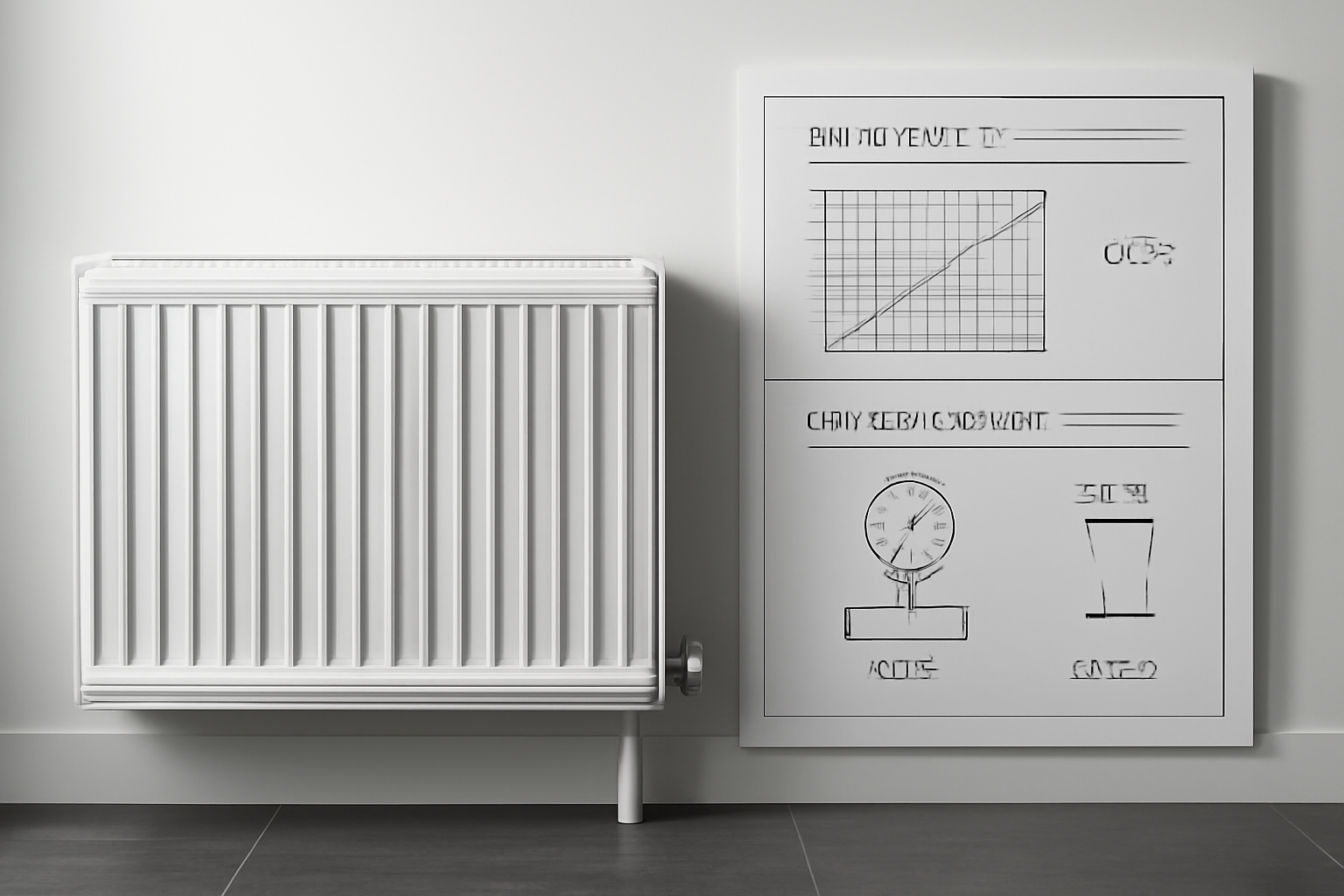
Steel Radiator Datasheet Explained: How to Match Heat Output, ΔT, Working Pressure, and Connections to Your Project
Choosing a steel radiator is not simply a matter of selecting a convenient size or an attractive finish. The correct radiator must deliver enough heat under the operating conditions of the building, connect properly to the pipework, withstand the system pressure, and fit the available wall space.
A steel radiator datasheet contains the technical information needed to make that decision. However, values such as heat output, ΔT50, working pressure, and connection size are easy to misinterpret if they are considered separately.
This guide explains how to choose a steel radiator for a project by turning datasheet information into practical buying decisions.
Why the Steel Radiator Datasheet Matters
A datasheet is the technical reference for a radiator model. It normally includes dimensions, heat output, material, surface finish, operating limits, connection details, weight, and installation information.
These specifications should be checked against the project rather than viewed as isolated product features. For example, a radiator with a high nominal output may not provide the required heat if the heating system operates at low water temperatures. Similarly, a radiator that fits the wall may be unsuitable if its connection arrangement does not match the pipework.
The most important questions to answer are:
- How much heat does the room require?
- At what water temperature will the system operate?
- What is the radiator’s tested heat output?
- Does its working pressure suit the building and heating circuit?
- Where are the flow, return, and air-vent connections?
- Will the radiator fit the available width, height, and projection?
Understanding Steel Radiator Heat Output
What heat output means
Heat output is usually expressed in watts (W) or kilowatts (kW). It represents the amount of heat transferred from the radiator to the room under defined test conditions.
Heat output depends on more than the radiator’s physical size. It is affected by the radiator design, number of panels or convector fins, dimensions, water temperature, room temperature, water flow rate, installation position, and test standard or method.
For this reason, a heat-output figure should never be treated as a universal value that remains unchanged in every installation.
What “steel radiator heat output at ΔT50” means
The term steel radiator heat output at ΔT50 refers to the radiator’s rated output when the mean water temperature is 50°C above the room air temperature.
For a commonly used test condition of 75/65/20°C:
- Flow water temperature: 75°C
- Return water temperature: 65°C
- Mean water temperature: 70°C
- Room temperature: 20°C
- Mean temperature difference: 70 – 20 = ΔT50
If a datasheet lists 1,500 W at ΔT50, that output applies to the stated test condition. It does not mean the radiator will always produce 1,500 W in service.
How to use a ΔT correction
When the actual system operates at a different temperature difference, the output must be corrected. Manufacturers commonly provide a correction table or an exponent for the radiator model. The exact correction factor depends on the radiator design and its tested performance.
For example, a system operating at 55/45/20°C has a mean water temperature of 50°C and a room temperature of 20°C, giving ΔT30. A radiator rated at ΔT50 will produce substantially less heat at ΔT30. The radiator may therefore need to be larger, deeper, or have additional panels or convector elements.
Do not apply a generic correction value when the manufacturer provides model-specific data. Use the datasheet or the supplier’s selection calculation wherever possible.
Steel Radiator Sizing for Low-Temperature Heating
Low-temperature heating systems are increasingly used with heat pumps, condensing boilers, weather compensation controls, and energy-efficient buildings. These systems can operate more efficiently with lower flow temperatures, but radiators deliver less heat as the temperature difference falls.
Steel radiator sizing for low-temperature heating should therefore begin with the design flow and return temperatures, not with the ΔT50 rating alone.
A practical sizing process
- Calculate the room heat requirement. Use a proper heat-loss calculation that considers room dimensions, insulation, windows, ventilation, external temperatures, and adjacent spaces.
- Confirm the design temperatures. Identify the planned flow temperature, return temperature, and indoor design temperature.
- Calculate the design ΔT. Use the mean water temperature minus the target room temperature.
- Convert the datasheet output. Apply the manufacturer’s correction data from the published test condition to the actual design ΔT.
- Select a practical radiator size. Check width, height, depth, wall clearance, heat output, and installation constraints.
- Allow for control and balancing. Thermostatic valves, flow rates, pipe sizing, and system balancing influence real-world performance.
For a heat-pump project, a radiator selected only from its ΔT50 output may be undersized. A larger radiator or a higher-output configuration may be needed to meet the room load at lower water temperatures.
Working Pressure: What to Check Before Buying
Steel radiator working pressure is the maximum continuous operating pressure that the radiator is designed to withstand under the manufacturer’s stated conditions. It is commonly expressed in bar.
The required pressure depends on the building height, system arrangement, static pressure, expansion vessel settings, safety controls, and the type of heating circuit. A tall building or high-rise application may impose different requirements from a small residential installation.
Working pressure versus test pressure
These two values should not be confused:
| Specification | Meaning | How to use it |
|---|---|---|
| Working pressure | The pressure permitted during normal operation | Compare it with the maximum design pressure of the heating system |
| Test pressure | A pressure applied during factory or quality testing | It is not the pressure at which the system should operate continuously |
| Maximum operating temperature | The highest permitted water temperature | Check it against the boiler, heat pump, controls, and system design |
Always select a radiator with a suitable safety margin and verify the complete system design. The radiator is only one component in a pressurized circuit, so valves, fittings, pipework, heat sources, and safety devices must also be compatible.
Radiator Flow and Return Connections
Connection details determine whether the radiator can be installed easily and whether it will work correctly with the planned pipework. The datasheet should identify the connection type, connection size, location, and recommended flow direction where relevant.
Common arrangements include:
- Bottom connections: Often used where pipes are concealed in the floor or wall and a cleaner appearance is required.
- Side connections: Common for traditional two-pipe installations and replacement projects.
- Opposite-end connections: Flow and return are positioned at opposite ends to support even water distribution in suitable radiator designs.
- Same-end connections: Both pipes are connected at the same side, subject to the radiator manufacturer’s instructions.
- Reversible or multi-connection layouts: Some models provide more than one connection option, but the available configuration must be confirmed from the datasheet.
Do not assume that a radiator can be connected in any direction simply because several threaded openings are visible. Some models include internal flow paths, integrated valves, inserts, or specific requirements for the air vent and blanking plug.
Before ordering, compare the radiator connection layout with the existing pipe centres, valve type, wall position, and required pipe route. In refurbishment projects, connection compatibility can be as important as heat output.
Material, Construction, and Stainless Steel 304
Many panel radiators are made from formed and welded steel, then protected with a prepared and painted surface. The construction can include water panels, convector fins, brackets, a top grille, and side panels. The exact configuration affects heat output, weight, depth, and appearance.
Stainless steel 304 is an austenitic stainless steel that contains chromium and nickel. Its chromium content supports the formation of a passive oxide layer, while nickel contributes to its austenitic structure and corrosion resistance. It is widely used where a clean appearance and improved resistance to atmospheric corrosion are required.
However, stainless steel 304 is not automatically the best material for every heating circuit. Performance also depends on water chemistry, chloride exposure, oxygen ingress, temperature, fabrication quality, weld condition, and system maintenance. Stainless steel radiators should still be selected according to the manufacturer’s approved application and the water quality requirements of the heating system.
Dimensions, Installation Space, and Practical Fit
A radiator can meet the heat requirement and still be unsuitable if it does not fit the installation area. Check the following dimensions in the datasheet:
- Overall width and height
- Radiator depth or projection from the wall
- Connection centres
- Wall-to-pipe and wall-to-radiator clearances
- Bracket positions and fixing requirements
- Clearance from floors, window boards, furniture, and curtains
- Weight when filled with water
Wall construction is also important. A steel radiator filled with water can place a significant load on the brackets and fixing points. Use suitable anchors and follow the installation instructions, especially on plasterboard, lightweight partitions, or insulated external walls.
Radiator Specification Checklist
Use this radiator specification checklist before approving a selection:
| Item | What to confirm |
|---|---|
| Room heat load | Required output in watts or kilowatts from a heat-loss calculation |
| Design temperatures | Flow, return, and indoor room temperatures |
| Heat output | Output at the project’s actual ΔT, not only at ΔT50 |
| Dimensions | Width, height, depth, connection centres, and available wall space |
| Working pressure | Compatibility with the system’s maximum operating pressure |
| Temperature rating | Compatibility with the heat source and control strategy |
| Connections | Thread size, flow and return positions, valve compatibility, and venting |
| Finish and material | Suitable coating, corrosion environment, and maintenance requirements |
| Installation | Brackets, fixing method, clearances, and filled weight |
Common Buying Mistakes to Avoid
Choosing by dimensions only
Two radiators with the same width and height can have different outputs because their panel configuration, depth, and convector design differ.
Using ΔT50 for every system
ΔT50 is a useful comparison point, but it is not the actual output for every installation. Low-temperature systems require corrected calculations.
Ignoring the return temperature
Heat output depends on the mean water temperature, so both flow and return temperatures matter. Looking only at the flow temperature can lead to an incorrect estimate.
Confusing test pressure with working pressure
A high factory test pressure does not mean the radiator should operate continuously at that pressure. Always use the published working-pressure rating.
Ordering before checking connections
Connection locations and pipe centres should be confirmed before purchase, particularly when replacing an existing radiator or working with concealed pipework.
Frequently Asked Questions
What is ΔT50 on a steel radiator datasheet?
ΔT50 is the rated mean temperature difference between the radiator water and the room air. A typical 75/65/20°C test condition produces a mean water temperature of 70°C and a room temperature of 20°C, giving ΔT50.
Is a higher wattage radiator always better?
Not necessarily. The radiator should match the calculated room heat loss and the system’s operating temperatures. Oversizing may be acceptable for control flexibility, but the valve, pipework, wall space, and system balancing must also be suitable.
How do I size a steel radiator for a heat pump?
Start with the room heat-loss requirement and the heat pump’s design flow and return temperatures. Convert the radiator’s published output to the actual ΔT using the manufacturer’s correction data. A radiator that appears adequate at ΔT50 may be too small at lower temperatures.
What does radiator working pressure tell me?
It identifies the maximum pressure the radiator is designed to withstand during normal operation. Compare this value with the heating system’s maximum design pressure, not merely its typical pressure during everyday use.
Can I reverse the flow and return connections?
That depends on the radiator design. Some radiators permit flexible connection arrangements, while others require a defined flow direction for correct internal water distribution or valve operation. Follow the datasheet and installation instructions.
Is stainless steel 304 suitable for every heating system?
Stainless steel 304 offers good general corrosion resistance, but suitability depends on water chemistry, chloride levels, oxygen exposure, temperature, weld quality, and the manufacturer’s application requirements. Material selection should be made for the complete system environment.
Conclusion
The best way to choose a steel radiator for a project is to read the datasheet as a complete specification rather than focusing on one headline number. Match the radiator’s corrected heat output to the room heat loss, calculate performance at the actual design ΔT, verify working pressure and temperature limits, and confirm the flow and return connections before ordering.
When these details are checked together, the radiator is more likely to provide the required comfort, operate efficiently, and install correctly on the first attempt.
Contact Us
For product information and help choosing the right solution, contact Isti Radiator.