


How to Compare Steel Radiator Heat Output at Different ΔT Ratings Before Buying
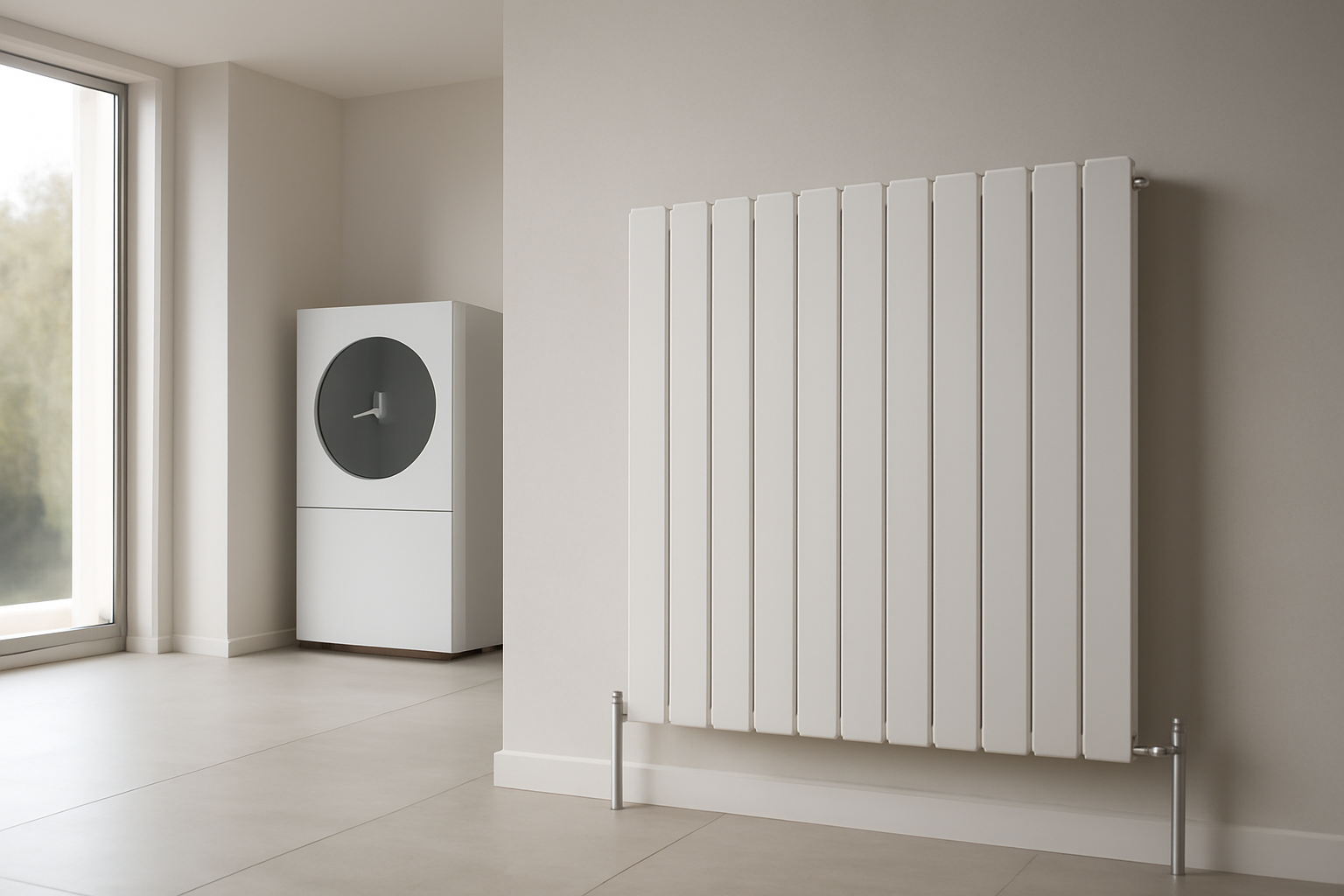
How to Compare Steel Radiator Heat Output at Different ΔT Ratings Before Buying
Choosing a steel radiator is not simply a matter of comparing height, width, panel type, or appearance. The most important question is whether the radiator can deliver enough heat for the room under the actual operating conditions of your heating system.
This is especially important when you are selecting radiators for a heat pump. Heat pumps generally operate at lower flow temperatures than conventional gas boilers, which means a radiator advertised with a high output at one ΔT rating may deliver considerably less heat in a low-temperature system.
Understanding steel radiator heat output at different ΔT values helps you compare products fairly, avoid undersizing, and make better decisions for renovations, new homes, replacement projects, and energy-efficient heating systems. This guide explains what ΔT means, how EN 442 radiator output ratings work, and how to compare radiators before buying.
What Does ΔT Mean in Radiator Heating?
In radiator specifications, ΔT means the difference between the average water temperature inside the radiator and the room air temperature. It is not simply the difference between the boiler flow temperature and the room temperature.
The standard calculation is:
ΔT = average radiator water temperature − room temperature
For example, if the water enters a radiator at 55°C and leaves at 45°C, the average water temperature is 50°C. If the room temperature is 20°C, the radiator operates at ΔT30.
Common radiator rating conditions include:
- ΔT50: traditionally associated with higher-temperature boiler systems.
- ΔT40: often used for reduced-temperature boiler operation.
- ΔT30: commonly relevant to heat pumps and low-temperature heating.
- ΔT20 or lower: possible in highly efficient systems or very low-temperature operation.
As ΔT decreases, the radiator becomes cooler and its heat output falls. This is why a radiator rated at 2,000 watts under ΔT50 conditions should not automatically be expected to deliver 2,000 watts when connected to a heat pump operating at lower temperatures.
Why EN 442 Radiator Output Ratings Matter
EN 442 radiator output ratings provide a standardized way to test and compare radiator performance. The standard specifies test conditions, including room temperature, water temperatures, measurement procedures, and performance reporting.
However, the number shown in a product catalogue is only meaningful when you know the ΔT rating behind it. Two radiators may appear to have similar outputs, but one may be rated at ΔT50 and the other at ΔT30. Comparing those figures directly can lead to a serious sizing error.
When reviewing a technical datasheet, look for:
- The stated heat output in watts.
- The ΔT condition used for the rating.
- The radiator dimensions and panel configuration.
- The flow and return temperatures used in the test.
- The stated room or ambient temperature.
- The standard or test method used.
A professional comparison should always use the same ΔT basis. If one product is rated at ΔT50 and another at ΔT30, convert the values or request data for the operating condition you actually expect to use.
How Steel Radiator Heat Output Changes at Different ΔT Ratings
Radiator heat output does not decrease in a simple one-to-one relationship with ΔT. As the temperature difference falls, output reduces according to the radiator’s performance curve and its tested exponent. The exact result depends on the radiator’s design, dimensions, water temperature, flow rate, connection arrangement, and test conditions.
A general correction formula is often used:
Corrected output = rated output × (actual ΔT ÷ rated ΔT)n
Here, n is a radiator-specific exponent. It is commonly close to 1.3, but the correct value should come from the manufacturer’s data where available.
Illustrative comparison of output
The following table uses an example radiator rated at 2,000 watts at ΔT50. The figures at lower ΔT values are illustrative estimates using a typical correction exponent. Actual output will vary by radiator design and manufacturer data.
| Operating condition | Approximate ΔT | Illustrative output | Output compared with ΔT50 |
|---|---|---|---|
| 75/65/20°C | ΔT50 | 2,000 W | 100% |
| 65/55/20°C | ΔT40 | Approximately 1,500 W | Approximately 75% |
| 55/45/20°C | ΔT30 | Approximately 1,050 W | Approximately 52% |
| 45/35/20°C | ΔT20 | Approximately 600 W | Approximately 30% |
This example explains why a radiator that appears suitably powerful on a ΔT50 catalogue page may be too small for a heat pump. At ΔT30, the same radiator may provide close to half of its ΔT50 output, depending on its construction and tested characteristics.
How to Size Steel Radiators for a Heat Pump
Learning how to size steel radiators for a heat pump begins with the room’s heat loss, not the existing radiator size. The heat loss calculation should account for the building envelope, windows, insulation, ventilation, outdoor design temperature, desired indoor temperature, and room use.
Once the required room output is known, follow these steps:
1. Establish the required heat output
Suppose a room requires 1,800 watts at the design outdoor temperature. This is the target heat output the radiator must deliver under the selected system conditions.
2. Confirm the heat pump’s design temperatures
Ask the installer or system designer for the expected flow and return temperatures. A heat pump may operate at different temperatures depending on outdoor conditions, weather compensation settings, emitter size, and the required domestic comfort level.
For example, a system designed around 55/45/20°C operates at approximately ΔT30. A system designed around 45/35/20°C operates at approximately ΔT20. These conditions require substantially more radiator surface area than a conventional 75/65/20°C system.
3. Use the radiator’s output at the actual ΔT
Do not size from the ΔT50 figure unless your heating system will genuinely operate at that condition. Use the manufacturer’s table for ΔT30, ΔT20, or another relevant rating. If only one rating is provided, request a correction table or calculate an estimate using the manufacturer’s stated exponent.
4. Check available wall space
Low-temperature systems often require larger radiators, deeper radiator types, multiple panels, or additional convector fins. Measure the available wall width, height, pipe positions, furniture clearance, and window location before choosing a model.
5. Allow for control and balancing requirements
Radiator performance also depends on correct water flow. Thermostatic valves, lockshield settings, pipe sizing, pump control, and system balancing all affect how much heat the radiator can transfer. A correctly sized radiator may still perform poorly if flow is restricted or the system is not balanced.
What Makes a Steel Radiator Suitable for Low-Temperature Heating?
Low-temperature steel radiators are selected by combining sufficient surface area with a design that transfers heat effectively at reduced water temperatures. A larger radiator is not automatically better, but greater effective surface area generally helps compensate for lower ΔT.
When comparing models, consider:
- Panel count: Multiple-panel radiators usually provide more output than a single-panel radiator of the same height and width.
- Convector fins: Fins increase the effective heat-transfer area and can raise output within the same overall footprint.
- Depth: Deeper configurations may offer higher output but require more wall clearance.
- Length and height: Increasing dimensions increases the available emitting surface, subject to the product design.
- Connection type: Flow distribution and connection position can influence real-world performance.
- Control compatibility: The radiator should work with the valves, thermostats, and control strategy used by the heating system.
Always compare like with like. A compact panel radiator, a finned panel radiator, and a decorative steel radiator may have very different outputs even when their external dimensions are similar.
Steel Radiator or Stainless Steel 304?
When a project specifies stainless steel 304, it is important to understand that this is not simply a cosmetic version of ordinary painted steel. Stainless steel 304 is an austenitic stainless steel alloy containing chromium and nickel. Its chromium content helps form a passive layer that improves resistance to corrosion, while nickel supports its structure and corrosion performance.
Stainless steel 304 can be a strong choice where appearance, durability, hygiene, or corrosion resistance is important. However, material grade alone does not determine radiator heat output. Output still depends on the radiator’s design, dimensions, water temperature, flow, surface area, and test conditions.
A stainless steel 304 radiator may therefore have a lower, similar, or higher output than another steel radiator of comparable size, depending on its construction. Compare the certified or stated wattage at the same ΔT rather than assuming that the material grade guarantees a particular performance level.
Common Buying Mistakes to Avoid
Comparing watts without checking ΔT
This is the most common mistake. A wattage figure without its test condition is incomplete.
Replacing an old radiator with the same size
An existing radiator may have been selected for a high-temperature boiler. Reusing its dimensions in a lower-temperature heat pump system may result in insufficient heat.
Using a rule-of-thumb room calculation
Watts-per-square-metre estimates can be useful for early budgeting, but they do not replace a heat-loss calculation. Insulation, glazing, ceiling height, air leakage, and external exposure can change the actual requirement significantly.
Ignoring the coldest design conditions
A system that heats adequately during mild weather may struggle on the coldest design days if the radiators were undersized. Select radiators for the intended design condition and confirm how the heat pump responds during peak demand.
Choosing the largest radiator without checking the system
Oversizing is usually less problematic than undersizing, but the radiator must still fit the room, coordinate with the controls, and suit the hydraulic design. Excessively large or deep radiators may create installation and aesthetic issues.
A Practical Steel Radiator Buying Checklist
- Obtain the heat-loss requirement for each room.
- Confirm the design flow and return temperatures.
- Calculate the actual ΔT from the average water temperature and room temperature.
- Compare radiator outputs at the same ΔT rating.
- Check EN 442 test data or equivalent manufacturer information.
- Verify the radiator dimensions, panel type, depth, and connection positions.
- Allow for valves, pipework, furniture, curtains, and wall clearance.
- Confirm that the selected material and finish suit the installation environment.
- Have the system balanced after installation.
Frequently Asked Questions
Is a radiator’s ΔT50 output useful for a heat pump?
Yes, but only as a reference point. A ΔT50 rating allows comparison when all products use the same test condition, but it does not represent the radiator’s actual output in a lower-temperature heat pump system. For selection, use the output at the heat pump’s expected ΔT.
What ΔT should I use for a heat pump radiator?
There is no universal value. Many low-temperature systems are assessed around ΔT30, while some installations operate closer to ΔT20 or another design condition. Use the flow and return temperatures provided by the heating designer and calculate the corresponding average water temperature.
Do larger steel radiators always produce more heat?
Not necessarily. Larger dimensions generally create more heat-transfer area, but output also depends on panel construction, convector fins, water flow, connection arrangement, and test conditions. Compare the published output at the same ΔT.
Can I convert a ΔT50 rating to ΔT30?
You can estimate it with a radiator correction formula, but the result is only approximate unless the radiator’s specific exponent is known. The most reliable option is to use the manufacturer’s output table for ΔT30 or request verified technical data.
Does stainless steel 304 automatically provide higher heat output?
No. Stainless steel 304 describes the material grade and its corrosion-resistant properties. Heat output depends primarily on radiator design, dimensions, water temperature, flow, and test conditions.
Should I oversize radiators for a heat pump?
Radiators often need to be larger for heat pumps because the system operates at lower water temperatures. The correct approach is to size them from the room heat loss at the intended design ΔT, rather than adding an arbitrary percentage without checking the system requirements.
Conclusion
A reliable radiator comparison starts with the operating condition, not the headline wattage. To choose the right product, identify the room heat loss, confirm the heat pump’s flow and return temperatures, calculate the actual ΔT, and compare steel radiator outputs using the same test basis.
Understanding EN 442 radiator output ratings and the effect of lower ΔT makes it easier to select efficient, properly sized radiators for modern homes. Whether you choose conventional steel, low-temperature panel radiators, or stainless steel 304, the final decision should be based on verified output, suitable dimensions, correct water flow, and the real requirements of the heating project.
Contact Us
For product information and help choosing the right solution, contact Isti Radiator.